Showing posts with label literature. Show all posts

Thursday, January 1, 2009

2008: Books


Sadly, I've had nowhere near the opportunity to read as much quality literature as I would like this year, less time and focus to write about the things I've read, and I have only a handful of real stand-out recommendations. The two best books I've read this year are Housekeeping by Marilynne Robinson and The World Without Us by Alan Weisman.

I certainly hope (heck, resolve!) to pick up the pace of reading and writing this year. Until then, here's the list. And always, very few actual 2008 releases, since I like to read in paperback:

Fiction:
Housekeeping, Marilynne Robinson
The Easter Parade, Richard Yates
Out Stealing Horses, Per Petterson
Then We Came to the End, Joshua Ferris
Homage to Catalonia, George Orwell

Non-Fiction:
The World Without Us, Alan Weisman
The Trouble With Diversity, Walter Benn Michaels
Brand Simple, Allen P. Adamson
The Long Tail, Chris Anderson
The Substance of Style, Virginia Postrel

Jim Shepard's collection of short stories Like You'd Understand, Anyway deserves mention for a few excellent stories in the collection ("The Zero Meter Diving Team," "Pleasure Boating in Lituya Bay"), but uneven quality throughout. Shepard's collection suffered from plots, characters, and scenarios that were over-imagined, forcibly too unique and consequently, made it hard for me to achieve any real empathetic connection. I'll completely damn Miranda July's No One Belongs Here More Than You with the same criticism, as well. A collection I fully expected and hoped to like, but one that was altogether too indulgent in its quirkiness for its own good.

Well, so much for 2008. The pile of books for 2009 is already a two feet high, so it's time to get going...

Tuesday, September 23, 2008

Agency Life

All life we work but work is a bore / If life's for livin' then what's livin' for?
- Ray Davies, The Kinks, "Oklahoma U.S.A"


EM rightfully called it out over dinner last night - maybe I'm not cut out for office work, because my tolerance for bullshit is too low. Maybe that's why, despite the neat literary narrative trick that Joshua Ferris' employs in his quite enjoyable Then We Came To The End, in which our perspective is implied and subsumed in the narrator's royal 'we,' I still most closely identified with Tom Mota. Yes, vulgar and slightly unhinged Emerson-quoting, clown-suit wearing, paintball-shooting Tom Mota. Imprison, then enlisted, then dead Tom Mota. Also, the star of the show.

Let me take two steps back. First, yeah, I'm not sure I enjoy spending all of my time and creative energy working for other people, but that said, I'm pretty good at it, and I've thus far managed a string of pretty reasonable gigs - enterprising, creative, and cubicle-free. So, in a world of complaining, I can't complain. And the work, while often too consuming of my time and mental energy, has also been reasonably intellectually challenging and has, if not added to the sum total of good in the world, probably not detracted from it. And I've made some friends and won some respect along the way. And probably learned a few things.. So, as Carl Spackler might say, I've got that going for me. Which is nice.

Second, in our lives, we spend maybe eight hours a day working and eight hours sleeping? Something like that? So it is amazing how few really useful or interesting novels there are about work (or sleeping, for that matter). Particularly good old fashioned, 20th century American office work. TV shows? Yes. Movies? Maybe. I guess those are the appropriate media. But novels? Nicholson Baker's Mezzanine, maybe? Richard Yates' Revolutionary Road, perhaps, although that had a good bit of sex, insanity, marital strife, and abortion in it, none of which really constitute much of my work day. Some Updike that I've missed, perhaps?

Which is what makes Joshua Ferris' Then We Came To The End such a pleasurable read. It is slightly cartoonish, but does a great job of elevating the everyday drama of office life to the appropriate levels of meaning, humor, and warmth. The work, a team of creatives in a large advertising agency in Chicago on the downswing of the dot-com boom, is surely recognizable to anyone who has worked in a creative field, or heck, in any professional services industry. The odd contours of office camaraderie, the strange insistence of minor professional triumphs and failures into your psyche, the tchotchke's that stand-in for personality and a personal touch, the elevator banks, and the office lighting.

It is all wincingly recognizable, and all laid comically bare. The read is quick and well-paced, and wrapped with enough grazing passes at the soul of the organization man and the small flourishes of craft (those that put the meta in fiction), to balance being an enjoyable subway read (as you head to your office) with taking heavy-handed swipes at the raison d'etre of your workaday life. Certainly recommended if you've ever had the pleasure of nine to five work.

Thursday, September 18, 2008

My Gal: Saunders on Sarah Palin

From The New Yorker, in case you missed it. An excerpt:

Explaining how she felt when John McCain offered her the Vice-Presidential spot, my Vice-Presidential candidate, Governor Sarah Palin, said something very profound: “I answered him ‘Yes’ because I have the confidence in that readiness and knowing that you can’t blink, you have to be wired in a way of being so committed to the mission, the mission that we’re on, reform of this country and victory in the war, you can’t blink. So I didn’t blink then even when asked to run as his running mate.”

Isn’t that so true? I know that many times, in my life, while living it, someone would come up and, because of I had good readiness, in terms of how I was wired, when they asked that—whatever they asked—I would just not blink, because, knowing that, if I did blink, or even wink, that is weakness, therefore you can’t, you just don’t. You could, but no—you aren’t.

That is just how I am.

Do you know the difference between me and a Hockey Mom who has forgot her lipstick?

A dog collar.

Do you know the difference between me and a dog collar smeared with lipstick?

Not a damn thing.

We are essentially wired identical.


Read the rest.

Saturday, February 23, 2008

The January Reading List

The Trouble With Diversity, Walter Benn Michaels

Only because you can't write about the books you read in January in March. So I read Walter Benn Michael's The Trouble with Diversity. He's rhetorically excellent, the first two chapters were fairly compelling arguments for class (and against race) as the meaningful bases for combating social ills in the United States. I intend to write about a few sections in greater detail, as I have the book heavily bookmarked, but have not done so yet.

Here's to better luck reading in February '08... oh, forget it. Maybe March?

Thursday, January 17, 2008

Is A Woman

ED was kind enough to invite me to a reading up at Symphony Space the other night, on behalf of 826 Valencia, in Brooklyn. ED gets to be judgmental because well, hell, she's a teacher. And she bought the tickets. I'm not and I didn't, so I don't have too much to say, as way of criticism. Charming and doing-good and maybe a little too-sweatery-and-cutesy, and yes, maybe Park Slope didn't need it the most. But whatever, and whatever.

The evening featured Zadie Smith moderating, George Saunders (looking like the Civil War himself), Vendela Vida, and Maggie Gyllenhaal (foxy, but also sister of foxy, and dating foxy, so whatever, whatever) reading the story "Roy Spivey" by Miranda July (foxy). And not to stir up controversy, but I'm pretty sure Peter Sarsgaard beats up on Jake at family picnics and whatever. At least, I hope they fight. And Sarah Vowell introducing and Dimitri Martin in the crowd. He's funny, my impression from ladies I know in New York is that he makes ladies swoon. But he seemed goofy, and I've seen him in the bookstore on Prince, and his hair seems like it takes a lot of time to get it that helmet-like.

There's probably a lot to say about the reading, but only one notion of consequence caught my attention. Zadie Smith said that Miranda July wrote about what it felt like to be in a woman's body better than anybody she could think of (sic, right?) and that held my imagination. After staring at people on the subway, ED and I took up this idea, although ED seemed to think that it meant only that Miranda July did an exceptional job describing what it felt like to be inside a specific type of woman's body (the gangly, awkward, overly self-aware type), or perhaps, that only a certain type of woman would recognize themselves in Miranda July's characters (either the gangly, awkward types or the self-aware types, and, of course, the Venn diagram intersection of the two types). ED's argument, as she indicated by a fat woman sitting across from us, and a snub-nosed girl reading a novel (that ED recognized by cover alone), was that most women aren't reflective enough to see themselves in their own bodies. No, they'd rather read The Devil Wears Prada or The Nanny Diaries or whatever, because they delude themselves into thinking that they actually are like those girls. Or that's what I got.

Maybe so, but this isn't what caught my imagination, and I don't think it is what Zadie Smith was getting at. Put differently, I don't think I'd do a good job writing about what it felt like to be in a man's body, although I could probably do a great job writing about what it feels like to be in my body. But that's because I think my body probably doesn't work exactly like most men think their bodies work... by which I mean the sweat and the stench and, especially, the blue balls. But it's an interesting idea, and one that I don't know I have a great example of -- who writes what it feels like to be inside of your own body (in my case, a man's body) exceptionally well. What it feels like to hang on the bones, and feel the skin, and understand the muscles and the blood and the pulses, strains, awkward twangs, and heat of the muscles. That there's such a thing that you could writePublish Post that would be commonly recognizable -- that this is a man's body, different from a boy's body, and different from a woman's body. And a hell of a compliment for Zadie Smith to play Miranda July.

EDITOR'S NOTE: ED has informed me that I got everything wrong, so you can't hold it against her.

Sunday, January 6, 2008

The December Reading List

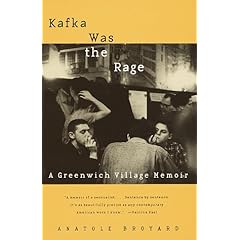
Kakfa Was the Rage, Anatole Broyard
The White Castle, Orhan Pamuk

I read two books in December (work was killing me). Anatole Broyard's memoir about Greenwich Village in the 1940s and 50s was great. I wrote about it at length, here. Orhan Pamuk's Nobel Prize-winning wannabe mind-bender was Meh. I wrote about it, briefly, here.

Here's to better luck reading in January '08. Get literate!

Wednesday, January 2, 2008

Kafka Was The Rage

As we move further into the future, the moment in which American culture indelibly changes seems less like San Francisco in 1968 or 1969, characterized by protest kids, free love, and the psychedelic movement spilling onto the shores of the American mainstream, but the era that immediately preceded it, in Greenwich Village from the close of World War II until, perhaps, the moment Bob Dylan plugged in at Newport. Perhaps my romanticizing of New York City underwrites this, but having read Prime Green, On the Road, and now Anatole Broyard's slim, personal, and wonderfully-observed memoir Kafka Was the Rage, it seems that from the GI's returning to New York to be taught by the exiles of WWII, to the beats and jazz, to folk and then the initial revved up dischord of rock and roll, downtown New York in the 50s and early 60s is where America really began to change.

The revolution seems simple: sex, drugs, a popular embrace of intellectualism, as a means to sex, an embrace of drugs, as a means to seeming intellectual, and the re-birth of American individualism, now manifest not on the frontier, but in the city, as a rejection of the corporate ethic of the 1950s. Here is the fundamental rift in popular culture, where both the darkness and the light slipped in. Here is the rift that opened, in which political protest (civil rights, anti-war) found voice, cultural change (embrace of sexual liberation and drugs, elevation of rock and roll to art and art to rock and roll, multiculturalism, rejection of wife, kids, house, job as an approach to living) began to be pervasive, and the spiritual center shifted (individualistic, psychedelic). Or so goes my half-baked thesis.

Anatole Broyard's memoir is an account of these changes, told at close-quarter. Beginning with Broyard's return from the war, his education, both personal and academic, in a new America, at the hands of a lover named Sheri and a host of emigre professors at the New School, continuing through a Greenwich Village obsessed with art, culture, and change, and never quite finding a conclusion, due to Broyard's death, the memoir still provides a shimmering view into a post-War New York City which launched many of the social trends that defined 20th century America, and are still reverberating across the world today.

A few selected passages, as encouragement for you to pick up this slim volume as accompaniment on your next train or plane ride of modest length:
"Auden lived around the corner on Cornelia Street and I often saw him scurrying along with his arms full of books and papers. He looked like a man running out of a burning building with whatever of his possessions he'd been able to grab. He had a curious scuttling gait, perhaps because he always wore espadrilles.

He came hurrying into the stationery store just as we were going out. Sheri was in front of me and he ran right into her. As he wrote somewhere, fantasy makes us clumsy. He also said that the art of living in New York City lies in crossing against the lights.

Sheri, who floated instead of walking, was easy to knock over, and Auden had all the velocity of his poetry and his nervousness. She fell backward, and as she did, she grabbed Auden around the neck and they went down together, with him on top. I was so concerned about her skirt flying up that I didn't even stop to think about whether she might have been hurt. She was lying on the floor beneath one of the most famous poets of our time, but I couldn't see the poetry or the humor of it.

She clung to Auden, who was sprawled in her arms. He tried desperately to rise, scrabbling with his hands and his espadrilles on the floor. He was babbling incoherently, apologizing and expostulating at the same time, while she smiled at me over his shoulder, like a woman dancing."
To fully appreciate that quote, I guess you need to know that Sheri doesn't wear underpants.
"For most of the people in Meyer Schapiro's class at the New School, art was the truth about life -- and life itself, as they saw it, was more or less a lie. Art, modern art, was a great, intense, but at the same time vague promise or threat, depending on how you looked at it. If civilization could be thought of as having a sexuality, art was its sexuality.

With the dim stained-glass light of the slides and the hushed atmosphere, Schapiro's classes were like church services. Culture in those days was still holy. If he had chosen his own church, it would have been Romanesque -- yet there was something fundamentalist in him, too. He made you want to get up and testify, or beat a tambourine."
While writing jazz criticism:
"I had always liked old jazz -- from Louis Armstrong to Lester Young -- but I hadn't made up my mind about Charlie Parker, who was everybody's hero at the time. While he could be brilliant, I found in Parker's style a hint of the garrulousness that would soon come over black culture.

Also, it seemed to me that jazz relied too much on improvisation to be a full-fledged art form. Nobody could be that good on the spur of the moment. And there was too much cuteness in jazz. It stammered and strained. It took its sentimentality for wisdom."
About emerging writers in Greenwich Village:
"They were writer-intellectuals in a sense that Faulkner, Hemingway, and Fitzgerald -- and the generation before them -- were not. Not even Joyce was an intellectual to the degree that they were.

It worried me, this bookishness of theirs. I was afraid I would never be able to keep up with it. I didn't have the patience to spend whole days reading. I was too restless. And I was too much attracted to the world. I read only for what I needed to know, or what gave me pleasure; I never read out of any abstract hunger for knowledge. Also, I was suspicious of bookishness."
About 1947:
"To someone who hasn't lived through it, it's almost impossible to describe the sexual atmosphere of 1947. To look back at it from today is like visiting a medieval town in France or Italy and trying to visualize the life of its inhabitants in the thirteenth century. You can see the houses and the cathedral, the twisting streets, you can read about the kind of work they did, the food they ate, or about their religion, but you can't imagine how they felt; you can't grasp the actual terms of their consciousness."
Even if I have just quoted you the best passages, don't you want to read it?!

Monday, December 31, 2007

2007: Books

A good year for reading, on subways and airplanes, in India and Rhode Island and New York and California. My recommended reads, if you haven't already got to them (very few 2007 releases, since I read in paperback):

Fiction:
A Bend in the River, V.S. Naipul
Appointment in Samarra, John O'Hara
Bright Lights, Big City, Jay McInerney
Gilead, Marilynne Robinson
The Adventures of Huckleberry Finn, Mark Twain
Play It As It Lays, Joan Didion
The Insanity Defense, Woody Allen
In Persuasion Nation, George Saunders
Disgrace, J.M. Coetzee
The Road, Cormac McCarthy
Tree of Smoke, Denis Johnson
The Spy Who Came in from the Cold, John Le Carre
Giraffe, J.M. Ledgard

Non-Fiction:
Fiasco, Thomas Ricks
The Year of Magical Thinking, Joan Didion
Prime Green, Robert Stone
Class Matters, Correspondents of the New York Times
Planet of Slums, Mike Davis
Kafka Was the Rage, Anatole Broyard

Little write-ups of each book can usually be found in the month in which I read the book. Search the site if you are interested in more detail on anything listed.

Wednesday, December 26, 2007

The White Castle

When I was young, 14 to 17, I loved Kafka and Borges. I have to assume that I still do, although I haven't revisited either in four or five years, at least. So why do I have such little attachment or reaction to the obvious antecedents of these writers? Orhan Pamuk's The White Castle (not to be confused with Harold and Kumar Go to White Castle, which was hands-down funnier, probably did a better job of evoking early 21st century New Jersey than The White Castle did for Istanbul, and maybe even handled issues of Western influence on the Eastern mind with equal aplomb [OK, that's debatable]) is a novel that is built on the slim shoulders of Kafka and Borges. Abstract, employing narrative in the service of ideas, symbolic, attempting to fold itself into an origami of narrative logic, demanding very little emotional attachment, evocative of generalities, not specifics.

While the novel has enough character to engage throughout, it's great intellectual questions never rise above mild interest, and the plot and setting offer so much promise for texture and depth of understanding, which are never really delivered. The wink-wink literary intellect supporting the whole thing never pays off, making the novel tough to write about -- it feels like a novel that requires investigation and response, except that it simply does not elicit that response. Perhaps this essay on Pamuk's new collection of essays probably does a good job of summarizing feelings that I don't feel strongly enough to want to summarize.

Sunday, December 9, 2007

The November Reading List

Faceless Killers, Henning Mankell
Amsterdam, Ian McEwan
Planet of Slums, Mike Davis
Giraffe, J.M. Ledgard
The Best American Poetry of 2007

This write-up is past due, and as it creeps further past deadline, I can only guess that I don't really want to write it. Not because the books I read this month were bad. They weren't. They ranged from the really excellent (Giraffe) to the good (Planet of Slums, Faceless Killers) to the grudgingly good (Amsterdam) to the about as good as I expected it to be (The Best American Poetry of 2007). I really have no excuse for balking at this, beyond over-work and holiday malaise. So here goes.

I've already written about J.M. Ledgard's debut novel Giraffe. It was everything I like in a novel - cleanly written, mysterious, elegant, smart, relating the bizarreness of our worlds, internal and external, with the drabness of our worlds. Read it.

Planet of Slums was an onslaught of dispiriting statistics, anecdotes, and analyses of macro-development trends, also very good, if not exactly heartening. A worthwhile look into what will surely be one of the most relevant and emotionally affecting stories of development in the next fifty years.

I picked up Faceless Killers on a whim in Penn Station, needing a good book to read over Thanksgiving. I had no context for Henning Mankell's murder mystery, set in the ice-blue winter of southern Sweden, and purchased the book solely on the strength of its appealing cover design, dust jacket accolades, and the desire for a wintry murder mystery. Faceless Killers was good in exactly the way murder mysteries are good. It managed to create suspense and an internal propulsion and gravity, from nothing in particular, other than brutal and senseless acts of violence, half-presented and unaccountable facts, speculation, an ensemble of odd, reticent characters, and the anxiety of the movement inherent in solving a mystery (or so I gather). The cold Swedish winter and the political color added by Europe's growing xenophobia in the face of an influx of immigrants and refugees added some, if not significant, texture to the novel. A more than worthwhile travel read.

I liken Ian McEwan's novels to M. Night Shyamalan's movies (I was going to suggest Spielberg, but I would be selling Spielberg short) -- accomplished, displaying an absolute mastery of form, engaging from start to finish, marvelous in construction, but more than a little contrived, and leaving me without a clear sense of purpose, at novel's end. So with Amsterdam. I can't dis-recommend the novel. It was good, generally interesting. It's necessary trope, at the novel's climax, was more than a little forced, and other than painting touches of the general anxiety of aging and nodding its head at the machinations of modern political intrigue, I'm not entirely sure what was holding the center of the novel. Probably nothing.

In this season of Best Ofs, well, you get a good sense of their worth. Compendiums for the uninitiated. Something to thumb through for those with a sense for what they like. So with The Best American Poetry of 2007. Not entirely clear why this is a recommended purchase over simply picking up a literary quarterly, but, hey, it wasn't bad, either.

The Best American Poetry 2007

While I think it is pretentious to sit in a bar (or on a train) and discuss poetry, if you are not a poet, I still do it anyhow. I am one of the very few people I know (RM and MP being the only others that come to mind), who actively care about and consistently engage with poetry. And, for good or bad, we have largely different tastes in this regard.

When it comes to poetry, I tend to like a few different kinds of poems. I enjoy poems that are written because the poet loves language - ranging from the clever, surprising, or inventive use of words to poems that are mostly just about the sounds of the words, treating them less as vessels of meaning, and more as things, that you might drop from a third story window, just to see what happened. I like poems that shine a light, that reach through time and space to allow you, the reader, and him/her, the poet, to share a moment of recognition, understanding, wonder, joy, or clarity. I do not, however, tend to like maudlin poems. I like poems that rattle a conceit, be it poetic, linguistic, literary, metaphysical, or whatever, in order to project a world. I tend to prefer a spare poem to a dense one, but I will take density if it offers entertainment.

I do not tend to read anthologies of poetry, more often flipping through magazines, and diving deeper into the body-works of poets who engage me. So, it was a bit of a whim that I bought The Best American Poetry of 2007, and I have to say, I was largely disappointed. A lot of poems, few of them bad, but only a handful really hit home. Here is a sampling of a few of my preferences:
Scumble by Rae Armantrout

What if I were turned on by seemingly innocent words such as "scumble," "pinky," or "extrapolate?"

What if I maneuvered conversation in the hope that others would pronounce these words?

Perhaps the excitement would come from the way the other person touched them lightly and carelessly with his tongue.

What if "of" were such a hot button?

"Scumble of bushes."

What if there were a hidden pleasure
in calling one thing
by another's name?

A Voice From The City by Louis E. Bourgeois

And why, Nephew, does this engine make you sad?

The night before the Communists invaded the city my uncle sat at the
stone table and was transfixed by a dozen ripe bananas lying there.
"Aren't they wonderful, Nephew? Isn't it wonderful that we should
have such fruit in our house? We are luckier than all the kings who ruled
over Cambodia -- they could have all the bananas they wanted but as
sated as they were, they could never eat them." My uncle was not an
optimist; he had simply grown unclear in the head. He didn't sleep, he
sat up all night at the stone table staring at the bananas -- two days later
they dragged him to the outskirts of town and shot him in the face for
wearing eyeglasses.

1975

Etymology by Marilyn Nelson

The filth hissed at us when we venture out --
always in twos or threes, never alone --
seems less a language spoken than one spat
in savage plosives, primitive, obscene:
a cavemob nya-nya, limited in frame
of reference and novelty, the same
suggestions of what we or they could do
or should, ad infinitum. Yesterday
a mill girl spat a phrase I'd never heard
before. I stopped and looked at her, perplexed.
I derived its general meaning from the context,
but was stumped by the etymology of one word.
What was its source? Which demon should we thank
for words it must be an abomination to think?

Sunday, November 25, 2007

Giraffe


From the back cover:
In 1975 secret police dressed in chemical warfare suits sealed off a zoo in a small Czechoslovakian town and orchestrated the slaying of forty-nine giraffe, the largest captive herd in the world.
Such is the premise for J.M. Ledgard's outstanding first novel, Giraffe. I am completely enamored of the novel, and may have only one quibble -- which is that while exposing the inhumanity and illogic of totalitarian (or, specifically, Communist) regimes has not slipped fully into irrelevance, it also lacks the immediacy that it once had. Beyond that, the novel is a gem: dreamlike in its prose, alternating passages charged with lyrical, political, and personal reflection, quiet desire, and electricity. The elements that I love best about prose writing and novels find a confluence in Giraffe: an elegant and understated style, a narrative that bends and blurs the edges of reality, without ever forcing us into the territory of the incredulous, an intense, indirect engagement with deep questions, and grounding it all, tethers to science, politics, and those utterly human things that drive the world, and provide the framework for those things that drive our hearts forward. Baroque praise, I'm sure, but well-earned. Giraffe is easily one of my favorite novels of the past few years.

Sunday, November 4, 2007

The October Reading List

The Spy Who Came in from the Cold, John Le Carre
Money, Martin Amis

Well, this will be short, at least. Work got in the way of a lot of reading this month, and while I'm still ploughing through a couple of books with different takes on the condition of the urban poor, all I finished this October are the two British novels above. I've already written about both (Amis' here, Le Carre's here) and I don't have much more to say. The Spy Who Came in from the Cold deserves perhaps another simple statement of praise - it was a really fun read. So there you go.

Thursday, November 1, 2007

Money by Amis

I was reading Money by Martin Amis. I saw RM. He said he loved it. Wasn't it so funny. I saw OES. He said he loved it. Wasn't it so funny. I saw NG. He said he loved it. Wasn't it so funny.

I don't have a lot to say about the novel. The first 100 pages were great. Words flew off the page, winning lines dropped coolly and casually, clever ideas crept in, were beat-up, discarded. And the sex, the drugs, the booze, and the money. 100 pages of percussion, beating, popping, slapping.
And then? Nothing much more. A few clever conventions. Not a lot of heart. Does that constitute a review? Probably not. But I don't have much else to say about Money.

Tuesday, October 16, 2007

Michael Clayton / The Spy Who Came In From The Cold

1. Denzel
2. Clooney

Simply put, that's how I see it at the top. The two movie stars that I will pay money to see, no matter what. The two movie stars that when we're old and gray, we'll still talk about, tell our grand-kids about. Like Grant, Bogart, Newman, Beatty, Redford. Big stars. Not Hanks. Not Cruise. Not Crowe. That's just how I see it, folks.

In case you care, other movie stars I would pay money to see: Depp. Clive Owen. Christian Bale. Owen Wilson, when he's melancholy. Walken, when he's serious. De Niro, when he's not being a sap. That's it, I think.

I think we should cancel the Democratic and Republican primaries and allow the electorate to pick two from among Denzel, Clooney, Oprah, and Letterman for who gets to run the country for the next eight years. I'm pretty sure the promise of a signed photograph would persuade even the most perverse of dictators and terrorist leaders to their senses. It's worth a shot.

After a late lunch at Mandoo, a Korean mandoo joint on 32nd Street (good, not great), ED and I caught an early evening showing of Michael Clayton. Numerous glowing reviews had got me excited, notably David Denby's in the New Yorker:
In the “Ocean’s” franchise and earlier movies, Clooney played guys who were on top of everything. He’s very intelligent, and it’s easy enough for him to point his chin, glare, and tell people off. But in “Syriana” and now in “Michael Clayton” he has done something more interesting: he’s playing clever guys who lack the killer instinct, who have some strain of personal honor that holds them back from simply winning.
You couldn't sucker me in to a movie any more easily. Coming in with these high hopes, it was with a curious combination of relief and dread that I felt them deflated by the steady onslaught of absolute crap in the previews. ED has good taste -- you can tell by the faces she makes at crappy previews. I wondered if I was in the wrong theater.

By the time Michael Clayton started, I didn't know what to expect. Thankfully, the crappy previews were a function of seeing the movie in midtown, not a prelude to the quality of the film. Michael Clayton was good, quite good, if a little too tidy. Clooney's graceful bemusement as he eases through the world, as a winner or a loser, is a charming thing to watch. Tom Wilkinson and Tilda Swinton's performances added sufficiently rich texture to Clooney's more narrowly-played protagonist, even if their respective pathos were just a little exaggerated. And I thought director Tony Gilroy's navigation of posh midtown law offices, hotel conference lobbies, Mercedes interiors, and corporate meeting rooms were effective in conveying a sinister menace through their sleek, perfectly appointed anonymity. And, of course, the movie's framing scene, with Clooney on a quiet hill in the chill light of a breaking dawn, was both beautiful and used to great effect.

---

When I got off the Q train yesterday morning, I dog-eared John LeCarre's The Spy Who Came In From The Cold on page 185. For no good reason, I had until now avoided reading any LeCarre, and had not read a page-turner in probably a few years. My mistake.

The thought had occurred to me to not get off the train, and keep riding uptown for another few stops. Or simply sit down in Starbuck's before going into the office. That would give me time to finish. But I didn't, and when I got back into the subway at Canal St. in the evening, I was livid to find that I had left the novel on my desk. One more day of suspense had to pass.

TSWCIFTC is great. It's hard and bleak, like a Cold War spy should be. It reflects the gray pallor cast over London and Berlin by the constant threat of double-cross and deceit. It twists and turns, turns back and twists again. Violence is taken for granted, yet there is both a professionalism and professional respect among the men who do the dirty work in the shadows of our fumbling diplomacy. The novel reads fast and with an impending sense of consequence. To the end, it's suspenseful and fun.

I have one quibble, and I will extend it back to Michael Clayton (corporate dirty work is our modern-day equivalent of Cold War espionage, no? Where we can recognize our enemies in ourselves, and aren't quite sure whose side we're on?) and perhaps extend it on to our dramatization of the professions of suspense, in general. My concern, of course, is the habit of adding a moralizing coda to each story, too often broadly wrought, as if to bring along the slower among our audience by saying "In addition to being suspenseful and cool, I am showing you how the world is fucked up, power corrupts, and ambition corrodes our sense of decency." A necessary point, always well illustrated throughout the substance of the book, but our auteurs' apparent concern that some among us might miss the point. From TSWCIFTC:
"Christ Almighty!" Leamas cried. "What else have men done since the world began? I don't believe in anything, don't you see - not even destruction or anarchy. I'm sick, sick of killing but I don't see what else they can do. They don't proselytise; they don't stand in pulpits or on party platforms and tell us to fight for Peace or God or whatever it is. They're the poor sods who try to keep the preachers from blowing each other sky high."
Don't we get this, through the betrayal of our protagonists? Through the abdication of justice finely meted, and the almost-always sacrifice of some lamb? In fact, don't those who who act out not just ambivalence, but actual acts of good or revelation generally crushed by the wheels of the machine, that is greater to them, and whose workings, only at the end, are revealed neatly to us?

Sunday, October 7, 2007

The September Reading List

The Road, Cormac McCarthy
The Muse Asylum, David Czuchlewski
Tree of Smoke, Denis Johnson
Last Evenings on Earth, Roberto Bolano
District and Circle, Seamus Heaney

The world is a desolate place. Do we need constant reminder of this? Through desert, dislocation, and strife, we still find hope and humor. God speaks through us. This is the thing we call humanity. And this?

I'm still not sold on the consequence of Cormac McCarthy's The Road as a parable of hope in troubled times. Does it shine a light of truth into the shadows of despair, showing us something we don't know or have forgotten? I have my reservations. But as a novel, both as entertainment, and as a spectral vision to haunt our dreams, I can only sing its praises. Where the story's spiritual conversation may not have found purchase with me, the landscape in which it is rendered is simply captivating. As I have written, from picking up The Road, I was not once in a position where I could put it down, even to sleep, without the greatest of reluctance. And, of course, if you can't take my word for it, there is always Oprah's.

David Czuchlewski's The Muse Asylum is a slim, smart, and breezy read about two recent college graduates, one an aspiring journalist, the other insane, who unravel a grand literary mystery that may or may not exist. In an advanced creative writing, I'm sure the novel gives way to layers of meaning and reference -- on the subway, it serves, as well, but more as entertainment. Not amazing, but accomplished for a first novel, and worth the read.

If the poet's job is to convey to us that the world is not only the prose we encounter every day (or, in that prose, there exist deeper avenues to meaning), Seamus Heaney consistently does the job. He does write in a foreign tongue, derived, I'd guess, from his love of an English language no longer practiced, and from the provincial world he inhabits and adores, deeply tinted in amber hues of a slightly more agrarian yesteryear that has not, in fact, entirely faded away. District and Circle is a neat set, in which each poem illustrates the poet as master of both language and something else: history, mechanics, or memory. Taken by the handful in the urban milieu of New York, the poems are transporting, a looking glass through which a simpler but more well understood world is apparent.

Denis Johnson's Tree of Smoke is an outstanding novel about war and life. You should read it.

Why Roberto Bolano has commanded so much of the literary world's attention in the last year still escapes me. Not that his writing isn't deserving, simply that the timing of the interest in his work, and the appearance of a number of high-profile works in translation is unclear to me. The collection of short stories Last Evenings on Earth is a perfectly good place to start (although, I have no other reference for Bolano), and of interest to any reader with a keen interest in the literary inheritance of the exiled artistic youth of Latin America's many dictatorships in the 70s and 80s, or for any reader with a taste for the spiritual children of Kafka and Borges.

Life During Wartime

In talking about one war, can we talk about another? Isn't every war somehow unique in its violence and its destruction, at least in the specificity of its theater, its actors, and its purpose? Or does war simply endure, each conflict an instance, wrought from the template of the same basic themes - of violence and illogic and a struggle for power, definition, and ultimately, meaning?

Denis Johnson's Tree of Smoke is a novel about Vietnam, impressive in its scope, as it traces the entanglements of a diverse ensemble of characters, Americans and Vietnamese, soldiers, spooks, and civilians, over the course of twenty years before and after their involvement in the war twists each of their lives. As always, Johnson's scenes and characters are luminously portrayed, shining from the pages with a religious intensity, and his language is direct and insistent, without sacrificing the capacity for poetry, vulgarity, or spiritual convalescence. The novel's center is held by the rogue and charismatic CIA operative Colonel FX Sands and his nephew, the idealistic (about espionage) new agent Skip Sands, and entwines a whole cast of supporting characters in their efforts to engage in psychological warfare and double-crosses against the North Vietnamese regime (although, the novel reads less as a neatly constructed spy thriller, tending towards dropping the reader in an alternating rhythm of lulls, bureaucratic misdirection, and introspection).

Through the conversations between the Colonel and his protege, Johnson provides us an inquiry into the nature of war, both in Vietnam and writ broadly:
"Did you hear Nixon's inaugural address?'
"No," Skip said. "Parts of it.'
"He talked about keeping commitments, preserving our honor - not about winning. Not about the future of Vietnam or the future of the kids we see around here. Nixon. I don't care what he says, you can see it in his eyes: he's played the whole game out in his mind, play by play, and we lose. That's how he sees it. Who did you vote for? The Democrat?'
"Nobody. I forgot to get a ballot.'
"I've always voted with the Democrats, this time reluctantly. Humphrey would have pulled us out even quicker, I think. The big boys see the big picture. So we lose. In the big picture it doesn't matter. When it comes to geopolitical balance, just the fact we've fought the war is enough. For the United States, it'll all be fine in the end. But I'm not fighting for the United States. I'm fighting for Lucky and Hao and folks like your cook and your housekeeper. I'm fighting for the freedom of real individuals here on this ground in Vietnam, and I hate to lose. It breaks my heart, Skip.'
"You think we'll actually lose? Is that what you think, ultimately?'
"Ultimately?" His uncle seemed surprised by the word. "Ultimately I think... we'll be forgiven. I believe we'll wander in the darkness for a good long time, and some of what we do here will never be made right, but we will be forgiven. What about you? What do you think, Skip?'
"Uncle, we're in a mess. A mess."
Tree of Smoke is about Vietnam, and in addition to the central pairing of the Colonel and Skip, two well-educated CIA men who end up with their hands deeply bound to the failed military commitments in Southeast Asia, the novel also relays to us the lives of missionaries, administering to the needs of the less fortunate, ravaged by war, of the Houston brothers, enlisted as a sailor and and a private, respectively, who succumb to the psychological damage of the front-lines of the war quite directly, and who, in a haunting literary trick, have been introduced to us, eventual fate and all, in Johnson's debut novel Angels. Knowing what sins a man commits, how the needle of his compass has been bent, in full, beforehand, enriches the experience of watching the sapling boy of that man get twisted up and scarred in the jungles of Vietnam. Johnson's particular empathy for his Vietnamese characters, humble people with full lives, dreams, and histories, lend a much-needed dimension to this war story, as well, elevating it above the proving ground of men and nations, reminding us of the toll paid by those native sons and daughters of the countries over which the American military marauds.

At 600+ pages, the novel moves swiftly, with its only fault being that it is, in some respect, a spy story with an inconclusive ending, a lock without a key. That Johnson is confronting quite directly the legacy of Vietnam, a war that has perhaps been forgotten by the popular culture, but whose consequences have not yet passed us. Of course, it is also impossible to read the novel without it casting a long shadow over our current war in Iraq. And anchoring it all is a much deeper investigation, psychological, moral, and spiritual, of the ways in which war succeeds and fails in giving us meaning.
The colonel said, "I went to Alaska once, you know. I toured the Alaska-Canada road they build their during the war. Fantastic. Not the road, the landscape. The mighty road was just this insignificant little scratch across that landscape. You've never seen a world like that. It belongs to the God who was God before the Bible... God before he woke up and saw himself... God who was his own nightmare. There is no forgiveness there. You make one tiny mistake and that landscape grinds you into a bloody smudge, and I do mean right now, sir." He looked red-eyed around himself, as if he only halfway recognized his environment. Sands willed himself not to be too disconcerted. "I met a lady who'd lived there for quite some years -- later, that is, just last Christmas is when I had the pleasure. An elderly woman now, she spent her youth and most of middle age near the Yukon River. I got to talking about Alaska, and she had only one comment. She said: 'It is God-forsaken.'
"You poor, overly polite sonsabitches. I read your silence as respect. I appreciate it too. Would you like me to get to the point?
"The lady's remark set me to thinking. We'd both had the same experience of the same place: Here was something more than just an alien environment. We'd both sensed the administration of an alien God.
"Only a few days before that, couple of days before at the most, really, I'd been reading in my New Testament. My little girl gave it to me. I've got it right now in my kit." The colonel half rose, sat back down. "But I'll spare you. The point is -- aha! yes! the bastard has a point and isn't too damn drunk to bring it home -- this is the point, Will." Nobody else ever called him Will. "St. Paul says there is one God, he confirms that, but he says, 'There is one God, and may administrations.' I understand that to mean you can wander out of one universe and into another just by pointing your feet and forward march. I mean you can come to a land where the
fate of human beings is completely different from what you understand it to be. And this utterly different universe is administered through the earth itself. Up through the dirt, goddamn it.
"So what's the point? The point is Vietnam. The point is Vietnam. The point is Vietnam."

Tuesday, October 2, 2007

Last Evenings on Earth


The decision to pick up Roberto Bolano's collection of stories Last Evenings on Earth was based entirely on how cool the cover was (green text on black, out of focus picture of men in white formal jackets back-lit by a car's headlights, full of the promise of women, wine, and violence), its prominent position on the display table of a downtown bookstore, and, of course, that they were short stories - perfect for subway reading. Having picked it up, it seems I can't avoid Bolano - see this Slate review of his novel and the companion NYT review.

Compared to most of the Norteamericano short story writers that I've come to know and love (Carver, O'Connor, Yates, Chaon, even Saunders), Bolano is cut from a different cloth. Starker, more abstract, falling much more from the overcoats of Kafka and Borges. The stories are interesting and resonant, but sketch a world in such a fundamentally different way. The language works as math or as poetry, at a level of symbol and abstraction that leaves me with the impression that the stories are less about people, real or fictional, than ideas. And those ideas are alien, too. Haunted by the political oppression of Chile, bearing the unique environmental and domestic textures of Mexico and Spain, populated by disconnected protagonists, fey, exiled, broken. The cumulative effect is disorienting, with only a handful of stories ("Anne Moore's Life," "Mauricio 'The Eye' Silva") offering clear purchase. The remaining stories offer a world, but through characters named B or X, using language that, in translation, seems to still require another act of decoding. But the world is still compelling and strange, and the stories offer transport clear into a foreign set of experiences. So, still worth a read.

Wednesday, September 26, 2007

Rave: The Road by Cormac McCarthy


Oprah's already blessed the novel long ago, so it doesn't really matter what I say. I'll chime in, nevertheless. I liked The Road by Cormac McCarthy. But I'm not sure that it was quite the spiritual revelation that all the back covers claim it to be. A page-turner, yes. The novel is compelling: every time you feel like you have to put it down to go to sleep, and you peek forward to find where the next logical break is going to come, well, when you reach that break, you just can't stop. You just have to keep going. The book's got the fire within it.

The novel is also haunting. The dystopian vision of America - the Mad Max future of people eating other people, a landscape of black and ash, of people scurrying in the shadows at the periphery of your vision, the mangled, wreckage of an industrial society - that vision stays with you, when you put the book down, once you've left the book. They're spectral and scary. If you've got a weak heart or frighten easily like a little girl, steer clear. You'll have nightmares. Of course, I believe America needs nightmares.

But does the novel have something to say about goodness in the world? Goodness in the face of nihilism and evil? I had a nice conversation about the novel this weekend at a wedding, where my friend spoke about how the novel illustrated the choices a father has to make to protect a child, whether by deciding how truthfully to describe a harsh world to a child, creating hope where none should exist, or by enacting extreme violence and inhumanity in defense of a child? She spoke also of how the novel projected hope, through the ability of the child to embrace hope, offer charity and kindness, and maintain faith against unspeakable odds. Well, I see it, I guess, but I'm not sure what The Road tells us that we didn't already know. What would a father do, but protect a child? And why wouldn't a child take pity on enfeebled creatures? Do we need a burned out landscape filled with raving packs of bearded cannibals to tell us that? And does it actually tell us anything? When compared with Lord of the Flies? Or Eichmann in Jerusalem? Is it our capacity for good in the face of evil that is really interesting? Or redeeming? Or our capacity for evil in the face of nothing that extraordinary?

But, let me return to my point: read this novel. It's fun. It works. It's a little disconcerting. You will want to finish it before you put it down.

And, also, take time to read this profile of Cormac McCarthy.

Sunday, September 9, 2007

The August Reading List

Indecision, Benjamin Kunkel
Less Than Zero, Bret Easton Ellis
The New, New Thing, Michael Lewis
Disgrace, J.M. Coetzee
Cosmopolis, Don DeLillo
Class Matters, Correspondents of the New York Times


J.M. Coetzee's Disgrace was in so many ways foreign to me, and all the more compelling for it. The first third of the novel introduces us to David Lurie, Professor of Communications at a Cape Town technical university, and chronicles his attempts to satisfy his desires and find sexual release within the constraints of his fifty-something, divorced lifestyle. Unsatisfied by his employment, where he is unable to engage his disaffected students in his deep poetic and literary interests, notably Keats, and perhaps slightly past his prime as a once rakish and successful womanizer, Lurie twice transgresses in what is left of his love life. First, when he accidentally encroaches on the anonymity demanded by the profession of a prostitute he has established a patronage of, and then again when he lures a young student of his into a brief, illicit affair.

The second of these affairs calls the wrath of the university, and in the novel's thematic concerns, a new cultural sensibility, crashing down on his head. Obstinate in his defense, admitting guilt to the act but unwilling to join the parade of his own condemnation, Lurie is forced into the hinterlands, to visit with his estranged daughter Lucy. Where the desires of an old but still virile codger are recognizable but not resonant for me (yet), it is in this visit to Lucy's farm, and the introduction of the cultural tensions specific to South Africa that Disgrace begins to move into deeper, bolder, and more foreign territory.

An event of horrific and gut-wrenching violence pivots the narrative, tenor, and impact of the book sharply - as both Lucy and David fall victim to an attack that is set in high contrast against the historical racial and colonial tensions of the country. In David and Lucy's approaches to coping with this event, as David finds himself further and further estranged from everything he thought he knew, Disgrace explores multiple layers of human conflict: of a man, a Romantic, in a world increasingly un-accommodating of that romance, of the difficulty of creating art in a world lacking in audiences, of men connecting with women, and of fathers connecting with daughters, and of course, against it all, of South Africa convulsing against its own legacy.

The power of the novel will be evident upon a read, and better yet, Disgrace is, for lack of a better word, a bit of a page turner, pushing the reader quickly through the narrative as it evolves from the kernel of one man's dissent with love and explodes into its historical and cultural themes. Completely recommended.

Class Matters, the collection of essays on class in America from New York Times columnists, is thoroughly engaging from start to finish. Tracing the evolution of class in America, mixing statistical analysis on economic standing with perceptions of class, mobility, and privilege, and surrounding those analyses with touching and illuminating case studies, portraits, and anecdotes, Class Matters is a provoking read. Of particular interest, and themes that I hope to return to soon, or the gaps between perception of class and economic standing, the leveling of those material signifiers of class in America as credit has allowed us to buy more things, and those things we buy are more common and more accessible, the binds between class and race, and class and immigration to this country, and class and the urban/suburban divide. Rich in data, analysis, and anecdote, Class Matters was excellent.

Don DeLillo's Cosmopolis is a slim volume that attempts to ask big questions about contemporary post-millenial, globalized and terrorized America. The novel's success is dubious. Chronicling a day in the life (and eventual and impending death) of Eric Packer, a 28-year old buy-you-and-sell-you billionaire, as he tries to cross Manhattan from east to west, Cosmopolis is a stilted, forced narrative that is much more about ideas than characters or plot, and even given that, about ideas that seem hardly as relevant or pressing as DeLillo seems to believe. All in all, disappointing, and even more so in contrast to a novel like White Noise, that managed to create full characters and a compelling narrative while also engaging some of the big ideas of the day.

The twin pairing of Benjamin Kunkel's Indecision and Bret Easton Ellis' Less Than Zero, both novels about lost generations of privileged American youth - in post-millenial New York, and in Reagan's Los Angeles, were devoured over a week-long business trip to Chicago early in the month. I've written about both already, and have nothing further to say about Less Than Zero, which I enjoyed not at all, at any level, and would certainly suggest you spend two hours watching the movie rather than the four hours it takes to read the book, if you are forced to. Kunkel's novel proves a bit more difficult. With a few weeks remove, I find it engaging, pretty smart, and an enjoyable-enough read. But I am still unconvinced of its final value, as the story wasn't that good, the characters were a bit too archetypal of people who aren't really archetypes, and a lot of smart pontificating was force-fit onto a somewhat unnecessary frame. So I am going to have to leave it filed under 'not bad,' although I have a nagging feeling that it deserves better. Or worse.

Michael Lewis' The New New Thing rounded out the month's reading list. While Michael Lewis is one of my favorite authors, The New New Thing was disappointing overall, largely as it served as hagiography of Jim Clark without really understanding or explaining what dynamics drive the successes and failures of innovation in an era, Silicon Valley during the Boom, that seems increasingly consequential, all of the rampant silliness aside. But you can read more about my take on the book over at the other blog.

All in all, a productive month of reading, if there was less of the highest quality work than I would have liked - largely determined by my predisposition to buy slim novels with nice covers, and my binge spending on books when forced into bookstores in airports or on rainy afternoons.