Showing posts with label music. Show all posts
Showing posts with label music. Show all posts
Thursday, January 1, 2009
2008: Music
Without much preamble:
Albums Released in 2007:
Alegranza, El Guincho
Sleep Forever, The Big Sleep
At Mount Zoomer, Wolf Parade
Venus on Earth, Dengue Fever
Vampire Weekend, Vampire Weekend
Stay Positive, The Hold Steady
Albums Discovered/Re-Discovered in 2007:
Brightblack Morning Light, Brightblack Morning Light
Comicopera, Robert Wyatt
Strange Geometry, The Clientele
The Body, The Blood, The Machine, The Thermals
Still Processing:
Vivian Girls, Vivian Girls
Alight of Night, Crystal Stilts
HLLLYH, The Mae-Shi
Analog Africa No. 4, Orchestre Poly-Rythmo de Cotonou
Everything That Happens Will Happen Today, David Byrne & Brian Eno


Tuesday, December 9, 2008
LCD Soundsystem - Losing My Edge
Ah, how I feel. Also, because they've taken down "New York, I Love You, But You're Bringing Me Down." Which is worth a look, you should find it. Also, James Murphy's brand of incredible danceable melancholy is worth a song in itself.
Monday, October 6, 2008
More Fulton Lights
Continued props to AG. This video is very cool, made long distance. Here's a little 21st century backstory from the auteur.:
A music video I made for Fulton Lights. Starring lead singer Andrew Spencer Goldman - despite the fact we've never met, and he lives in New York and I live in London. Through the magic of the internet machine and technology we overcame that slight geographical hitch.
(If it's glitchy and stuttering - hover over the video and turn off HD mode. It won't look as pretty but...)
Fulton Light's incredible new album can be listened to, and even downloaded, here:
fultonlights.com
I'd love to hear what people think of the video.
Give the director props on Vimeo.
Wednesday, September 24, 2008
Fulton Lights

Happy to report AG's new record as Fulton Lights is pretty damn good. You can listen to it for free, here.
Tuesday, September 23, 2008
Sound Travels
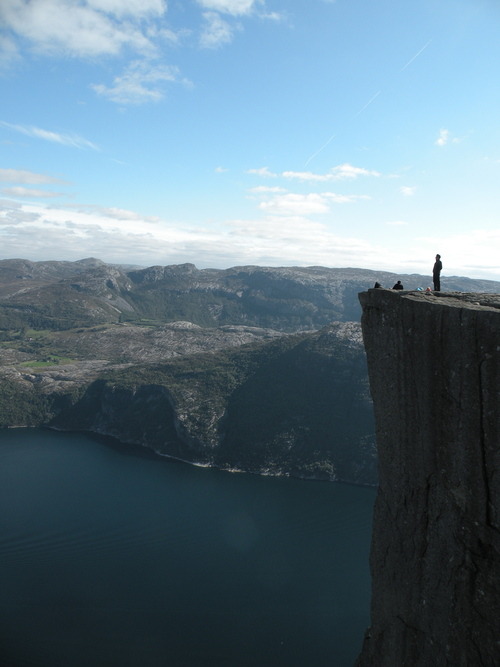
I'll do a short set of posts on Norway soon. But to get you started, check in on AG's travel blog, Sound Travels. The man behind Fulton Lights has taken off to see the world, spread the word, play some shows and, well, I don't know. Get up to as much no good as one can. I am envious and the swell of demand in my own soul for a third-life crisis grows stronger by the day.
Saturday, September 20, 2008
Justice Stress
I am not particularly a fan of Justice, but DL sent around a link to the video for "Stress" from his trip to BUG 09 in London and, having not seen the video before, damn. Pretty raw stuff, even if contrived for the video. I guess I'll relate the strange and senseless act of violence that I was tangentially involved in a few weeks ago, but living in New York city in 2008, sometimes you forget that the world can still be a pretty bleak and violent place.
Monday, July 28, 2008
Sleepwalk
Listening to the radio the other day, heard an interview with some young, new band that has a surf-rock sound. Apparently, they are from South Carolina, and the beach music from there is more like raved-up Motown than the Beach Boys. Think "Shout." Got me thinking about the beach and music, and while I wasn't a beach kid, I did grow up in a beach town, and the beach really is a great place to hear music. Got me thinking about this song, imagining what it must have been like to first hear this on the AM radio in 1959... and what I'm missing out on, that surprise and delight at hearing a haunting, new melody, since I don't really listen to the radio, and I don't really listen to pop music.
Sunday, June 1, 2008
Rave: The Big Sleep
 Alright, so I haven't been writing much about music lately. That's not because I haven't found that many good albums (it has been a little slow), but more so that I haven't had as much time to listen in depth, and haven't had that much time to write. I can recommend, in the last few months, the new Times New Viking (if you like GBV), the El Guincho record, and parts of the new Dengue Fever record. Also, I've caught up on and really like Brigthblack Morning Light and Robert Wyatt's Comicopera, as well as most of The Thermals record.
But, the new album from The Big Sleep - an immediate cause for praise and recommendation. A great, atmospheric, moody, dynamic collection of songs that also really fucking rocks. I saw the band open up for The Hold Steady last summer in Prospect Park, and hadn't been that immediately taken by a band that I'd never heard before since seeing the Arcade Fire open for the Wrens so many years ago at the Knitting Factory. They came out sounding assured and complete, with a sufficiently distinct sound to make me hungry for their album - whose release I apparently missed in my winter haze, but which I stumbled upon the other night. Worth it, as it consistently brings an alternating palette of sonic and lovely, just what I love so much in a good rock and roll band.
I am hoping for a show in New York soon, and if anyone wants to join, well, you can join.
Sunday, April 20, 2008
Death of the Label
 It is a Sunday evening, and I just finished reading The Long Tail by Chris Anderson, and am listening to a couple of new CD purchases while leafing through the internet (Destroyer's Trouble In Dreams and Robert Wyatt's Comicopera, if you care). So it seemed like a good time to read David Byrne's article in Wired magazine, "Survival Strategies for Emerging Artists," which served me as an additional point of view on what supposedly momentous shifts are happening in the music industry (and the entertainment industries, more broadly).
The article is worth a read, providing Byrne's perspective as an insider with multiple angles on the music came - as popularly successful act with the Talking Heads, as an independent artist, as a label executive (so to speak) with Luaka Bop. At a high level, the article casts the current music industry as very much in flux, as labels become less important and less necessary as the cost of production of music drastically declines with new recording tools, as the the platforms for marketing and distribution are radically shifting from traditional retail to online and even peer-to-peer, and as the fundamental economics of the business are being called into question. Byrne identifies six potential models of relationships that an artist can have with a label or other business partner, essentially ranging from giving up control and ownership in exchange for resources and a support infrastructure to maintaining control and ownership, but taking on the burden of financing and manufacturing and marketing logistics. I won't summarize the very readable article in much more detail as it is worth a read, and is interspersed with interviews with Thom Yorke from Radiohead and Mac McCaughan from Superchunk and Merge Records.
 A quick aside: having just read The Long Tail, which uses the music industry as an exemplar case for long tail marketing analysis (and, surely, it is, with low production costs, multiple, available distribution channels, a massively differentiated demand profile, and the need and tradition of having multiple levels of filters guiding consumers in refining their individual demand profiles), writing about the music industry and the continued evolution of models for connecting artists to audiences, either cutting out or simply introducing new middle-men always play as an interesting case study for the evolution of other long tail markets, characterized, beyond the long tail demand distribution, by products which are cheap to mass produce and distribute (all non-live entertainment, all software, some physical goods, some services).
In terms of the music industry, specifically, I always have a conflicting opinion from watching the evolution in the business from my personal music buying habits. I grew up on CDs, fundamentally digital, so I don't belong to high church of vinyl, but I still like purchasing CDs. I like albums better than singles. I go to shows. I still like going to the record store (granted, I've had the luck of living in New York, the Bay Area, and Rhode Island, where I've had good record stores). As much as I read music magazines (Spin when I was twelve, yes, Pitchfork, now), friends and the taste of record store clerks still guide a lot of my purchasing decisions. And I like to play my music on stereo speakers, out loud, not on my computer or iPod.
So, while the shift to purely digital production and marketing models are exciting, in that they provide new avenues for artists to create and distribute music, and, selfishly, new ways for great music to get to me, there still feels like there is a disconnect to me on how the industry will sufficiently evolve to help connect consumers of music with a greater selection of high quality music. Of course, this gets to the argument for filters from a book like The Long Tail, and while I am glad that record label executives are no longer the pre-release arbiter of good taste, it seems like the current avalanche of music actually may be oddly aligned against the ability of artists to produce music as art, and have that art reach a mass audience.
Right now, the best channels for producing great music are exactly those indie labels like Merge and divisions of bigger labels like Nonesuch, combined with the same music critic press that has always existed, just shifted to a new medium, that are identifying and promoting great music. And one of the potential negative consequences (not to the artists, perhaps, but to the consumer?) of more and varied means for artists to create and distribute music is that it will take more work for consumers to actually identify good music that they will like. Thoughts?
And two slightly related notes:
David Byrne makes passing reference to I Think Music, in his articles, which, at a glance, seems like an aggregator for distributing independent music. Any thoughts on the platform?
And finally, reading an interview with David Berman of the Silver Jews in the Village Voice. Apparently, the new album, coming out in June (which, of course, I am excited for) includes the chords for the songs in the liner notes. According to Berman:
I think in a Pitchfork interview, I did before Tanglewood Numbers came out—I did this long interview, and it was notorious because I explained how much money a person who sells 20,000 records will make. And people—it was shocking to them. It’s the last thing people will talk about, especially if you break it down. I think the latest way that I want to do that, with this album- the chords are all in the album. There are only sixteen chords on the whole album, and so, you always wonder why in the liner notes, bands don’t put their chords there? Its almost like bands are afraid to show how easy it may be. Why is that not often done? Most bands’ chords are only two or three; and people would cover their songs. There is no reason in the world, from a business standpoint—it's insane not to. If you put these things in there, you are encouraging young children to learn to play on them. And those are the people they go on to cover, maybe.Feels gimmicky, but gimmicks aren't so much Berman's thing, as far as I can tell (or would like to believe). And connects oddly to David Byrne's introduction to his piece, tracing music to its communal roots, as a fundamentally live and communally experienced act. Anything to it?
 Addendum. The Thom Yorke interview with David Byrne is also interesting, if for no other reason than how odd (and forward thinking) these two musical geniuses really are. For example:
Byrne: I've been asking myself: Why put together these things — CDs, albums? The answer I came up with is, well, sometimes it's artistically viable. It's not just a random collection of songs. Sometimes the songs have a common thread, even if it's not obvious or even conscious on the artists' part. Maybe it's just because everybody's thinking musically in the same way for those couple of months.
Yorke: Or years.
Byrne: However long it takes. And other times, there's an obvious...
Yorke: ... Purpose.
Byrne: Right. Probably the reason it's a little hard to break away from the album format completely is, if you're getting a band together in the studio, it makes financial sense to do more than one song at a time. And it makes more sense, if you're going to all the effort of performing and doing whatever else, if there's a kind of bundle.
And then this:
Byrne: Do you know, more or less, where your income comes from? For me, it's probably very little from actual music or record sales. I make a little bit on touring and probably the most from licensing stuff. Not for commercials — I license to films and television shows and that sort of thing.
Yorke: Right. We make some doing that.
Byrne: And for some people, the overhead for touring is really low, so they make a lot on that and don't worry about anything else.
Yorke: We always go into a tour saying, "This time, we're not going to spend the money. This time we're going to do it stripped down." And then it's, "Oh, but we do need this keyboard. And these lights." But at the moment we make money principally from touring. Which is hard for me to reconcile because I don't like all the energy consumption, the travel. It's an ecological disaster, traveling, touring.
Byrne: Well, there are the biodiesel buses and all that.
Yorke: Yeah, it depends where you get your biodiesel from. There are ways to minimize it. We did one of those carbon footprint things recently where they assessed the last period of touring we did and tried to work out where the biggest problems were. And it was obviously everybody traveling to the shows.
Byrne: Oh, you mean the audience.
Yorke: Yeah. Especially in the US. Everybody drives. So how the hell are we going to address that? The idea is that we play in municipal places with some transport system alternative to cars. And minimize flying equipment, shipping everything. We can't be shipped, though.
Tuesday, January 22, 2008
Pancho and Lefty
People ask lots of dumb questions. In real life conversations, and in fake conversations, i.e., interviews. One line of questioning that I always find difficult to answer is "What's your favorite book/movie/singer/song?" Favorite, of course, being a useless qualifier. More apt would be, what book still haunts you? What movie have you had to re-watch year after year? What song can you listen to over and over?
Townes Van Zandt's "Pancho and Lefty" is one of those songs that I can listen to over and over. In three taut verses, Pancho and Lefty manages to canvass an emotional territory as wide as Texas -- of sadness, pride, violence, guilt, regret, and embarrassment.
I offer you four versions of the song, none of which are perfect. The perfect version, as far as I know, exists on TVZ's Live at the Old Quarter. In fact, each of the versions provided, although three of them (the only ones that weren't huge hits) have distinct values, are sort of parodies... of the genre, of the song, of Bob Dylan. Still, in all cases, the song transcends the flaws of the performance. Enjoy.
Townes Van Zandt's "Pancho and Lefty" is one of those songs that I can listen to over and over. In three taut verses, Pancho and Lefty manages to canvass an emotional territory as wide as Texas -- of sadness, pride, violence, guilt, regret, and embarrassment.
I offer you four versions of the song, none of which are perfect. The perfect version, as far as I know, exists on TVZ's Live at the Old Quarter. In fact, each of the versions provided, although three of them (the only ones that weren't huge hits) have distinct values, are sort of parodies... of the genre, of the song, of Bob Dylan. Still, in all cases, the song transcends the flaws of the performance. Enjoy.
Friday, January 18, 2008
Just A Little Dusty...
... early in the morning. Walked into an almost empty office this morning, having slept not well at all, and DL had decided to start the morning off with Dusty In Memphis. One of my favorite albums, by far, and an album that is wholly and criminally under-appreciated, Quentin Tarantino's best efforts included...
Thursday, January 17, 2008
Thursday, January 10, 2008
Polite Dance Song
I'm not plugging the song (or band) necessarily, but the video for The Bird and the Bee's "Polite Dance Song?" Um, yes.
Tuesday, January 1, 2008
I'm Not There
 Let's start with what makes a popular biopic (that word I can't pronounce) of a popular musician, with Ray and Walk the Line our recent, obvious examples. First, the narrative should be straightforward, illustrating how the performer's enormous talent allowed him/her to rise from obscurity to fame, wealth, and acclaim, overcoming in the process whatever obstacles stand in his/her way. The narrative should not document a linear ascension from nothing, but rather, should document the many rises and falls (alcohol, drugs, women, prevailing bad attitude of the times , general bad attitude of our star) that the musician must endure through his career (although presented in a chronologically linear fashion).
A good biopic should make the music of the artist immediately approachable, even if you have never heard it before. The biopic should connect the music as directly possible with the person's life. You shouldn't need a lot of previous understanding of the music, or the person's life, or the cultural or social context in which the artist was making their art to appreciate the movie. You should be able to walk in to the movie, knowing fuck-all about the artist, and walk out two hours later humming the songs, with a greater appreciation for the artists struggles, and a clear idea how the artist's talent enabled him/her to overcome both personal and cultural turmoil to forever change the landscape of American music.
 Todd Haynes' I'm Not There probably fails against that standard of a biopic. It's convoluted, full of inside jokes, abstract and non-linear in its narrative, and, of course, doesn't include a single character called Bob Dylan. So what.
First, let me suggest why I think I'm Not There succeeds as a movie, in its own right. It's funny. It sends up or celebrates with humor so many of Dylan's contemporary cultural touchpoints (Baez, the Beatles, Ginsberg, Pete Seeger at Newport, the fans, the fans, the fans) and is also wonderfully witty in reference to Dylan's life and music ("C'mon, play your early stuff!" Blanchett's Dylan taunts a crucified Jesus). It's visually appealing and stylized, and feels like it contains at least three different movies in it. It has at least one transcendent performance (Blanchett) and a handful of good ones (Bale, Marcus Carl Franklin, Bruce Greenwood, Charlotte Gainsbourg, even David Cross' Allen Ginsberg cameo is equal parts jubilantly weird and amusing). And while it may not explain Bob Dylan, his work or life, to the lay audience, I think it does a damn good job channeling it.
Now, if you have more than a passing familiarity with Dylan, life and music, I think I'm Not There is extremely rewarding. At a superficial level, the characterizations of the mythic events in Dylan's career (the self-mythologizing tramp from Minneapolis, Robert Zimmerman, the Greenwich Village folk scene, the visit to Woody Guthrie's deathbed, Newport in '65, the Don't Look Back UK tour where he was cheered through the acoustic half of his set and booed through the electric half, turning his back on the protest kids, the Woodstock years, the Christian years) are smart and funny, and when un-jumbled chronologically, surprisingly direct. The stylistic sending up of the Dylan eras and their attendant documentarians (isn't Julianne Moore's Baez great?) are dead-on, if a little too knowing. And the music, while wandering beyond just the recognizable "hits," provides great context to the narrative and stylistic elements of the movie.
Where I'm Not There really takes off, I think, is that it does, actually, get at some of the very important things about Bob Dylan, albeit well below the skin, and in that discomforting way where yesterday, today, and tomorrow are all rolled into one. Through the movie, you come to understand that Dylan, for being anointed the voice of his generation, was always an artist badly out of place in his time - from his personal founding myth as a rail-riding Socialist all the way through to his distancing himself from the turmoil of the Vietnam era in search of a family life and eventually a passing comfort in Christ.
The figurative Richard Gere scenes, which everyone can apparently do without, investigate perhaps the most interesting part of Dylan's career, when he turned away from his music, and for all pop culture knew, lived in as an outlaw, in the wilderness as America profoundly lost its innocence. The confrontational Dylan, wise too young, shines through in Ben Whishaw's performance, as well as Blanchett's, clearly anticipating the damaged relationship between artist and fame.
Even the most deeply anachronistic narrative threads, in my opinion, those showing the collapse of the personal and spiritual life of the extremely wealthy and famous Dylan (the Heath Ledger and Christian Christian Bale sequences) are insightful in appreciating that Dylan not only bore the expectations of a (younger) generation and the scrutiny of an older generation which could sense but not understand its own demise (scored to Blanchett mouthing Stephen Malkmus' version of "Ballad of a Thin Man"), but Dylan also bore that unholy burden of being rich and famous.
 Let me also go ahead and say that, while the I'm Not There (Hendrix' "All Along the Watchtower," The original soundtrack isn't great end-t0-end, it has some pretty great tracks. It would be hard to argue that anything is an improvement over the Dylan originals, although Dylan has always been eminently coverable Byrds' "You Ain't Going Nowhere," The Band's "Tears of Rage," and "I Shall Be Released," George Harrison's "If Not For You," to name just a few where the cover competes with the original). Perhaps the Calexico-backed "Goin' to Acapulco" by Jim James and "Yankee" by Willie Nelson join those ranks. And, of course, I'm partial to the Sonic Youth, Malkmus, and YLT stuff... so, thanks, Todd Haynes. Great job on the movie and the music.
Monday, December 31, 2007
2007: Music
Sixteen years of musical fanaticism and (shamefully, I suppose), since making the modest shift from angst to melancholy, from Nirvana and Pearl Jam to Dinosaur Jr. and Luna in 1994 or so, I can't really say that my tastes have evolved all that much. When I flip through my year's purchases and play lists, it's still very much indie rock. And I get deeper in to Dylan. Ah, well. Here's 2007 for you, recommended, in all its glory:
Albums Released in 2007:
Fort Nightly, White Rabbits
Ga Ga Ga Ga Ga, Spoon
Night Falls Over Kortedala, Jens Lekman
Person Pitch, Panda Bear
Hissing Fauna, Are You The Destroyer?, Of Montreal
Challengers, New Pornographers
Friend Opportunity, Deerhoof
Boxer, The National
23, Blonde Redhead
Asa Breed, Matthew Dear
The Shaky Hands, The Shaky Hands
Live At Massey Hall, 1971, Neil Young
Let's Stay Friends, Les Savy Fav
Mirrored, Battles
Weirdo Rippers, No Age
Woke on a Whaleheart, Bill Callahan
Albums Discovered/Re-Discovered in 2007:
The Greatest, Cat Power
New Morning, Bob Dylan
Bringing It All Back Home, Bob Dylan
Dongs of Sevotion, Smog
Ce, Caetano Veloso
Writer's Block, Peter, Bjorn & John
Absolutely the Best, Ike & Tina Turner
The Remains, The Remains
The dBs, Stands for deciBels
Whatever People Say I Am, That's What I'm Not, Arctic Monkeys
Notable Songs:
If I were with it, a music critic, this list would be littered with hip-hop and country songs, M.I.A. and Gypsy-influenced emo. Sadly, I'm not. I still buy CDs, don't listen to the radio, and don't hear many singles. So you'll get mostly more indie rock. Sorry:
"Senor," Willie Nelson & Calexico
"Goin' to Acapulco," Jim James & Calexico
"I've Been Out Walking," Nina Nastasia & Jim White
"Myriad Harbor" and "Failsafe," The New Pornographers
"The Underdog" and "Rhythm & Soul," Spoon
"Pots & Pans" and "Brace Yourself," Les Savy Fav
"A Postcard to Nina," Jens Lekman
"No Cars Go," Arcade Fire
"Weird Fishes / Arpeggi," Radiohead
"Sycamore," Bill Callahan
"Bunny Ain't No Kind of Rider," Of Montreal
"Up Against The Wall," Peter Bjorn & John
"Bros," Panda Bear
"Tourist Trap," White Rabbits
Lessons learned? I'm a sucker for kick drums and horns...
If you want to know what the cool kids like (some of which I like, some of which I'm not as smitten by), here are the year end comps from Pitchfork, Stylus, Slate, and AllMusic.com.
Albums Released in 2007:
Fort Nightly, White Rabbits
Ga Ga Ga Ga Ga, Spoon
Night Falls Over Kortedala, Jens Lekman
Person Pitch, Panda Bear
Hissing Fauna, Are You The Destroyer?, Of Montreal
Challengers, New Pornographers
Friend Opportunity, Deerhoof
Boxer, The National
23, Blonde Redhead
Asa Breed, Matthew Dear
The Shaky Hands, The Shaky Hands
Live At Massey Hall, 1971, Neil Young
Let's Stay Friends, Les Savy Fav
Mirrored, Battles
Weirdo Rippers, No Age
Woke on a Whaleheart, Bill Callahan
Albums Discovered/Re-Discovered in 2007:
The Greatest, Cat Power
New Morning, Bob Dylan
Bringing It All Back Home, Bob Dylan
Dongs of Sevotion, Smog
Ce, Caetano Veloso
Writer's Block, Peter, Bjorn & John
Absolutely the Best, Ike & Tina Turner
The Remains, The Remains
The dBs, Stands for deciBels
Whatever People Say I Am, That's What I'm Not, Arctic Monkeys
Notable Songs:
If I were with it, a music critic, this list would be littered with hip-hop and country songs, M.I.A. and Gypsy-influenced emo. Sadly, I'm not. I still buy CDs, don't listen to the radio, and don't hear many singles. So you'll get mostly more indie rock. Sorry:
"Senor," Willie Nelson & Calexico
"Goin' to Acapulco," Jim James & Calexico
"I've Been Out Walking," Nina Nastasia & Jim White
"Myriad Harbor" and "Failsafe," The New Pornographers
"The Underdog" and "Rhythm & Soul," Spoon
"Pots & Pans" and "Brace Yourself," Les Savy Fav
"A Postcard to Nina," Jens Lekman
"No Cars Go," Arcade Fire
"Weird Fishes / Arpeggi," Radiohead
"Sycamore," Bill Callahan
"Bunny Ain't No Kind of Rider," Of Montreal
"Up Against The Wall," Peter Bjorn & John
"Bros," Panda Bear
"Tourist Trap," White Rabbits
Lessons learned? I'm a sucker for kick drums and horns...
If you want to know what the cool kids like (some of which I like, some of which I'm not as smitten by), here are the year end comps from Pitchfork, Stylus, Slate, and AllMusic.com.
Wednesday, December 26, 2007
Drinker's Peace + 2
The Wall Street Journal, The Weekly Standard, and Christoper Hitchens. I may read all three with a certain mixture of regard and disregard, but rarely do I link over. Today I'll make an exception, for Hitchens' review of Eric Felten's forthcoming Cocktails, Culture, and the Art of Drinking Well. RM has long been an admirer of Felten's reviews in the WSJ, I believe, and I am duly excited by the arrival of this book. I'm sure it will be well-worn copy, referenced often by Mssrs. M and W and myself. From Hitchens' review:
His remark about one or two but never three has been, I hope, lifted from my own axiom about the relationship between martinis and female breasts. One is too few. Three is too many. Two seems somehow superbly right. His second observation, about the girlie factor, is something that greatly preoccupies Felten. When all is said, isn't there something very slightly fussy about all this mixing and shaking and measuring: something, perhaps, fractionally light in the loafers?
Borrowing from an old Esquire distinction, he suggests that masculine cocktails involve whiskey whereas feminine ones "lean heavily on cream, fruit juices and crème de this-and-that." That seems fair enough, except that both he and Kingsley Amis (about whom there was nothing limp-wristed) demonstrate a high degree of affection for the "Irish Coffee" cocktail and the exquisitely careful means of making it. Of course whiskey, which Felten calls "that least feminine-seeming of spirits," is involved, so the honors here can be reckoned as about even.
I believe we are all agreed. And to off-set the war-mongering behind all of this, three from Uncle Bob and GBV, everyman's drinking man.
Sunday, December 16, 2007
Don't Stop Believin'
The annual year-end Best Of conversations are starting to tumble out, and the culture nerd in me is excited. Given that I didn't watch The Sopranos, I was a little bemused by Jody Rosen's decision on Slate to lead off her year end discussion with Journey... and more concerned that the YouTube clip was actually both really tepid and dorky. Because that song really does rock. Which closing a night of karaoke out a few weeks ago at Lulu's in Brooklyn with "Don't Stop Believing" only reinforced. That said, given that the song endures, there isn't a parallel logic that says ridicule of Journey shouldn't also endure. Because they were a ridiculous band. I wish I could find that clipping from the Eggers comic strip about Journey that ran in the SF weekly papers in 1996. Damn it!
Funny how out of touch I am with any year-end music list that focuses on singles. Since I routinely visit a very narrow sliver of the rock world with reverence, I definitely find myself out of step with the goings on in pop and hip-hop, and a little uncertain about the enduring qualities of a lot of the hits. In the same way that Journey endures as an alcohol fueled sing-along, so do Sir Mix-A-Lot's "Baby Got Back" or House of Pain's "Jump Around." Doesn't make them necessarily important or interesting, outside of the strictly populist sense. And just because most people can't sing along to "The Weight" or "Common People" or "Psycho Killer" or "Back to the Lake" (god help me if I ever find that in a karaoke bar...) doesn't mean I'll stop singing it.
In the meantime, awaiting the rest of the lists that come out that will simultaneously drive me insane and drive me to go directly to Other Music.
Monday, December 10, 2007
Another Night of Vomiting With Yo La Tengo

ED, TL, and LC drove out to Maxwell's on a cold and rainy evening to see the 6th night of YLT's Hanukkah celebration. After circling Hoboken twice in search of parking, we finally made it to the club. We grabbed a bite to eat, and then ducked into the backroom to catch the last three or four songs of Redd Kross' set. Heather Lawless then came on, and she was OK (the Variety Shac stuff is more charming, I think). TL slipped out mid-set. Then YLT came on. It was hot in the club. TL had come back, but LC left. After a while, TL went to find out what was wrong. YLT opened with a cover of "Eight Days A Week." They played a great version of "Autumn Sweater" and the droned-out but rhythmic sprawl of "Pass the Hatchet." TL had not come back. LC had not come back. ED and I went to find out what was wrong. Food poisoning!
If this was the first time that a guest had been poisoned at a YLT show, I wouldn't hold it against them. But it's not! (We don't blame Maxwell's. ED and I were fine. We blame Joe's Pub.)
In the meantime, satisfy yourself by reading Ira's blog about the shows, or this interview with James from AllMusic.com. Key quote:
If this was the first time that a guest had been poisoned at a YLT show, I wouldn't hold it against them. But it's not! (We don't blame Maxwell's. ED and I were fine. We blame Joe's Pub.)
In the meantime, satisfy yourself by reading Ira's blog about the shows, or this interview with James from AllMusic.com. Key quote:
JM: It's pretty shocking. In America, maybe above any other country in the world, people will just talk during a show. When I go out to see bands play, people will just talk through the whole thing. And text. Actually, texting isn't so bad just because it doesn't make any noise. It still boggles my mind that people will pay $20 each to get into a show and talk the whole way through it. When I'm elected mayor, I will make that...well, certainly a ticketable offense. Maybe more. I haven't decided exactly what the punishment would be for that.And, yes, I can refer to them by first name like I know them because, goddammnit, I once awkwardly introduced myself to them at the Commonwealth bar. So there. And now I'll fall asleep to "And Nothing Turned Itself Inside Out."
Tuesday, November 27, 2007
Expectations of a Kentuckian
Ian Svenonious interviews Will Oldham (and Chan Marshall and Kevin Shields and Mark E. Smith and so on and so on...) on an internet TV channel that I've never heard of before... Ultra-hip gets totally wired.
EDIT: Oh, fuck this. I should read further -- VBS is VICE magazine, dominating the uber-hip landscape for ever and ever... ah, well.
Subscribe to:
Posts (Atom)