Art by Thomas Doyle. Fantastic.
 Tell No One. French. Suspenseful. Economical storytelling. Lyric. Worth it, highly recommended.




 Alright, so I haven't been writing much about music lately. That's not because I haven't found that many good albums (it has been a little slow), but more so that I haven't had as much time to listen in depth, and haven't had that much time to write. I can recommend, in the last few months, the new Times New Viking (if you like GBV), the El Guincho record, and parts of the new Dengue Fever record. Also, I've caught up on and really like Brigthblack Morning Light and Robert Wyatt's Comicopera, as well as most of The Thermals record.
Patty: "(she lies down on the bed) You know what I'd like to do?"3. Navin avoids the homicidal sociopath:
Navin: "What?"
Patty: "Guess your weight."
Navin: "Hey, that would be interesting for me, no one has tried to guess my weight! You see, I guess their weights..."
Patty: "Put your arms up."
Navin: "This will give me a whole different perspective on this. (Patty squeezes Navin's backside) Hey! You're really trying to be accurate! Is it getting hot in here? Wait a minute - what's happening to my special purpose?"
Navin: "Get away from those cans! (Navin runs inside the station)"4. Navin defends himself against racist stereotypes:
Navin: "There's cans in there too! (the gas station window breaks)"
Navin: "More cans!"
Navin: "Select class. Very, very good."
Boss: "We'll keep the eggplants out!"
Navin: "Ah good! We don't want any vegetables."
Con Man: "Na, na. The jungle bunnies!"
Navin: "Oh of course! They'll eat the vegetables!"
Con Man: "Boss, could I talk to him? We're going to keep out the niggers!"
Navin: "The what?"
Boss: "The niggers! We'll keep 'em out."
Navin: "Sir, you are talking to a nigger!"
Navin: "Marie, are you awake? Good. You look so beautiful and peaceful, you almost look dead. I'm glad because there is something that has always been very difficult for me to say. I slit the sheet, the sheet I slit, and on the slitted sheet I sit. I've never been relaxed enough around anyone to be able to say that. You give me confidence in myself. I know we've only known each other four weeks and three days, but to me it seems like nine weeks and five days. The first day seemed like a week and the second day seemed like five days and the third day seemed like a week again and the fourth day seemed like eight days and the fifth day you went to see your mother and that seemed just like a day and then you came back and later on the sixth day, in the evening, when we saw each other, that started seeming like two days, so in the evening it seemed like two days spilling over into the next day and that started seeming like four days, so at the end of the sixth day on into the seventh day, it seemed like a total of five days. And the sixth day seemed like a week and a half. I have it written down, but I can show it to you tomorrow if you want to see it. Anyway, I've decided that tomorrow, when the time is right, I'm going to ask you to marry me, if that's o.k. with you. Just don't say anything. You've made me very happy."
9. When Navin sets Shithead free.
Navin: "And I don't need any of this! I don't need this stuff, (he pushes all of the letters off the desk), and I don't need you. I don't need anything except this (he picks up the ashtray) and that's it and that's the only thing I need, is this. I don't need this or this. Just this ashtray. And this paddle game, the ashtray and the paddle game and that's all I need. And this remote control. The ashtray, the paddle game and the remote control, and that's all I need. And these matches. The ashtray, and these matches, and the remote control and the paddle ball. And this lamp. The ashtray, this paddle game and the remote control and the lamp and that's all I need. And that's all I need too. I don't need one other thing, not one - I need this! The paddle game, and the chair, and the remote control, and the matches, for sure. Well what are you looking at? What do you think I am, some kind of a jerk or something? And this! And that's all I need. The ashtray, the remote control, the paddle game, this magazine and the chair."

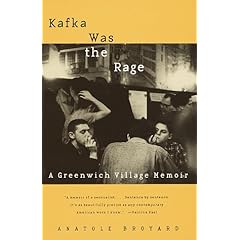 As we move further into the future, the moment in which American culture indelibly changes seems less like San Francisco in 1968 or 1969, characterized by protest kids, free love, and the psychedelic movement spilling onto the shores of the American mainstream, but the era that immediately preceded it, in Greenwich Village from the close of World War II until, perhaps, the moment Bob Dylan plugged in at Newport. Perhaps my romanticizing of New York City underwrites this, but having read Prime Green, On the Road, and now Anatole Broyard's slim, personal, and wonderfully-observed memoir Kafka Was the Rage, it seems that from the GI's returning to New York to be taught by the exiles of WWII, to the beats and jazz, to folk and then the initial revved up dischord of rock and roll, downtown New York in the 50s and early 60s is where America really began to change.
"Auden lived around the corner on Cornelia Street and I often saw him scurrying along with his arms full of books and papers. He looked like a man running out of a burning building with whatever of his possessions he'd been able to grab. He had a curious scuttling gait, perhaps because he always wore espadrilles.To fully appreciate that quote, I guess you need to know that Sheri doesn't wear underpants.
He came hurrying into the stationery store just as we were going out. Sheri was in front of me and he ran right into her. As he wrote somewhere, fantasy makes us clumsy. He also said that the art of living in New York City lies in crossing against the lights.
Sheri, who floated instead of walking, was easy to knock over, and Auden had all the velocity of his poetry and his nervousness. She fell backward, and as she did, she grabbed Auden around the neck and they went down together, with him on top. I was so concerned about her skirt flying up that I didn't even stop to think about whether she might have been hurt. She was lying on the floor beneath one of the most famous poets of our time, but I couldn't see the poetry or the humor of it.
She clung to Auden, who was sprawled in her arms. He tried desperately to rise, scrabbling with his hands and his espadrilles on the floor. He was babbling incoherently, apologizing and expostulating at the same time, while she smiled at me over his shoulder, like a woman dancing."
"For most of the people in Meyer Schapiro's class at the New School, art was the truth about life -- and life itself, as they saw it, was more or less a lie. Art, modern art, was a great, intense, but at the same time vague promise or threat, depending on how you looked at it. If civilization could be thought of as having a sexuality, art was its sexuality.While writing jazz criticism:
With the dim stained-glass light of the slides and the hushed atmosphere, Schapiro's classes were like church services. Culture in those days was still holy. If he had chosen his own church, it would have been Romanesque -- yet there was something fundamentalist in him, too. He made you want to get up and testify, or beat a tambourine."
"I had always liked old jazz -- from Louis Armstrong to Lester Young -- but I hadn't made up my mind about Charlie Parker, who was everybody's hero at the time. While he could be brilliant, I found in Parker's style a hint of the garrulousness that would soon come over black culture.About emerging writers in Greenwich Village:
Also, it seemed to me that jazz relied too much on improvisation to be a full-fledged art form. Nobody could be that good on the spur of the moment. And there was too much cuteness in jazz. It stammered and strained. It took its sentimentality for wisdom."
"They were writer-intellectuals in a sense that Faulkner, Hemingway, and Fitzgerald -- and the generation before them -- were not. Not even Joyce was an intellectual to the degree that they were.About 1947:
It worried me, this bookishness of theirs. I was afraid I would never be able to keep up with it. I didn't have the patience to spend whole days reading. I was too restless. And I was too much attracted to the world. I read only for what I needed to know, or what gave me pleasure; I never read out of any abstract hunger for knowledge. Also, I was suspicious of bookishness."
"To someone who hasn't lived through it, it's almost impossible to describe the sexual atmosphere of 1947. To look back at it from today is like visiting a medieval town in France or Italy and trying to visualize the life of its inhabitants in the thirteenth century. You can see the houses and the cathedral, the twisting streets, you can read about the kind of work they did, the food they ate, or about their religion, but you can't imagine how they felt; you can't grasp the actual terms of their consciousness."Even if I have just quoted you the best passages, don't you want to read it?!
 Let's start with what makes a popular biopic (that word I can't pronounce) of a popular musician, with Ray and Walk the Line our recent, obvious examples. First, the narrative should be straightforward, illustrating how the performer's enormous talent allowed him/her to rise from obscurity to fame, wealth, and acclaim, overcoming in the process whatever obstacles stand in his/her way. The narrative should not document a linear ascension from nothing, but rather, should document the many rises and falls (alcohol, drugs, women, prevailing bad attitude of the times , general bad attitude of our star) that the musician must endure through his career (although presented in a chronologically linear fashion).
 Todd Haynes' I'm Not There probably fails against that standard of a biopic. It's convoluted, full of inside jokes, abstract and non-linear in its narrative, and, of course, doesn't include a single character called Bob Dylan. So what.
 Let me also go ahead and say that, while the I'm Not There (Hendrix' "All Along the Watchtower," The original soundtrack isn't great end-t0-end, it has some pretty great tracks. It would be hard to argue that anything is an improvement over the Dylan originals, although Dylan has always been eminently coverable Byrds' "You Ain't Going Nowhere," The Band's "Tears of Rage," and "I Shall Be Released," George Harrison's "If Not For You," to name just a few where the cover competes with the original). Perhaps the Calexico-backed "Goin' to Acapulco" by Jim James and "Yankee" by Willie Nelson join those ranks. And, of course, I'm partial to the Sonic Youth, Malkmus, and YLT stuff... so, thanks, Todd Haynes. Great job on the movie and the music.
 Movies enjoyed (and recommended!) in 2007, both old and new. Caveats at the end:
 A good year for reading, on subways and airplanes, in India and Rhode Island and New York and California. My recommended reads, if you haven't already got to them (very few 2007 releases, since I read in paperback):
 Hooray for Henry!
 Went down to BAM with ED last weekend to see No Country For Old Men. Having not read the novel and been underwhelmed by the last few Coen brothers' movies, in comparison to my always high standards for them, I didn't have much by way of expectation. I must say that I always admire the dark humor that the Coen brothers use to line their violence, and their return to Texas was welcomed. While they might not be as vital as they were in their earlier films, the Coens have certainly mastered the period piece, at least when the period is the 80s or early 90s. Combined with the strange temporal context in which their films get absorbed, the desolate landscapes of West Texas form an evocative backdrop for the brutality and general weirdness of Josh Brolin and Javier Bardem's cat-and-mouse game. Tommy Lee Jones' weathered face and odd, funny ramblings, adds a third distinctive performance to the film, and the off-tempo philosophical coda ("some things happen for no reason / but obey the same calculus"), while somewhat disappointing in its lack of avenging bloodbath, provided an excellent close to the movie. That's my rambling take: Worth your while.
In 1975 secret police dressed in chemical warfare suits sealed off a zoo in a small Czechoslovakian town and orchestrated the slaying of forty-nine giraffe, the largest captive herd in the world.Such is the premise for J.M. Ledgard's outstanding first novel, Giraffe. I am completely enamored of the novel, and may have only one quibble -- which is that while exposing the inhumanity and illogic of totalitarian (or, specifically, Communist) regimes has not slipped fully into irrelevance, it also lacks the immediacy that it once had. Beyond that, the novel is a gem: dreamlike in its prose, alternating passages charged with lyrical, political, and personal reflection, quiet desire, and electricity. The elements that I love best about prose writing and novels find a confluence in Giraffe: an elegant and understated style, a narrative that bends and blurs the edges of reality, without ever forcing us into the territory of the incredulous, an intense, indirect engagement with deep questions, and grounding it all, tethers to science, politics, and those utterly human things that drive the world, and provide the framework for those things that drive our hearts forward. Baroque praise, I'm sure, but well-earned. Giraffe is easily one of my favorite novels of the past few years.