Showing posts with label india. Show all posts

Thursday, January 31, 2008

The Missing Indian Skyline


Walking down Fifth Avenue recently, I noticed an advertisement for a bank (I forget which bank) that displayed an imaginary skyline comprised of iconic buildings from the financial centers of the world. Without being certain, I felt there were many notable inclusions: Tokyo, Shanghai, Hong Kong, Singapore, Sydney, Kuala Lampur, Dubai, Paris, London, New York, Chicago, San Francisco. Notable in its omission (or inconspicuousness) was any iconic building from India.

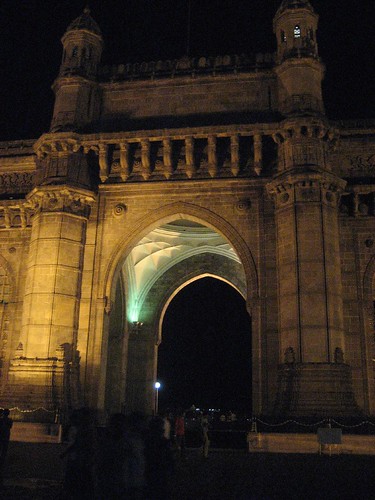
This got me thinking a little bit about Indian cities, and particularly, buildings in Indian cities. That the physical environment of India has a distinct characteristic is undeniable. Being in Mumbai, in Delhi, in Kolkata are all unmistakable experiences. India also has a rich heritage of iconic architecture: Red Fort, Victoria Memorial, the Taj Mahal, the Gateway of India. All of these monuments, however, are legacies of the Raj era, the British, or earlier periods. To my knowledge (and I am not as familiar with Chennai or Bangalore), there are not many iconic modern buildings in India.

Why should this be important? No reason, really, other than iconic modern buildings have a way of announcing the importance of the city to the world - hence the interest in China's CCTV building. And the recent growth in India's economy, as well as the rise of iconic architecture throughout the developing world, marks the absence of a signature Indian building as a curious absence. Which led me to this article, answering the question, but in a way that leads me to wonder if the collection of Indian architecture represented will truly become iconic? Or will they take on the utilitarian lack of character that you find at the end of so many Silicon Valley office parks, which appears to be the spiritual kin of the buildings portrayed in this slideshow?


Wednesday, April 11, 2007

Sanjaya: I'm in Your Corner

I am a snob. I dislike most of pop culture - by which I mean, prime time TV, blockbuster movies, top 40 music, and so on. This is not posturing, and I don't take secret and guilty pleasure in watching and listening to the majority of what the rest of America is paying attention to. This excerpt from Wikipedia pretty well captures everything that causes my confusion and disdain, I would assume:

On March 19, 2007, Howard Stern announced that he was launching a campaign with his listeners to vote for Malakar to win the competition. Some Stern regulars, such as Jeff The Drunk, have claimed to have voted for Malakar at least 300 times -- largely in hopes of tormenting Wack Pack member and American IdolEric the Midget. The weblog Vote for the Worst has Malakar as its current "pick" for the sixth season top 12 after previous candidates Antonella BarbaSundance Head were eliminated.

A few American Idol fans who use MySpace have claimed to be on hunger strikes. Other members of the MySpace online community who liked Sanjaya created a page entitled Team Sanjaya in support for him. However, members of the online community have contributed semi-fictional web sites such as Sanjaya-Idol, appearing to portray Sanjaya in a more satirical but supportive way. A 13-year-old girl named Ashley Ferl was highlighted repeatedly during Malakar's performance in the Top 11 episode, crying tears of joy, although Ferl also cried for Melinda Doolittle, Jordin Sparks, and many other contestants.

Last night, while I was working in my parents' study, the shouting started. "Sanjaya! It's Sanjaya! Sanjaya's on!" My parents were in their bedroom, watching TV. My parents do not watch American Idol and have never seen Sanjaya perform before. I'm not sure how they found out about him, but I'm not sure how they could have avoided it. "You can come in after the commercial!" my dad added, helpfully.

I wandered in. I had no choice. Standing in the doorway to my parents' room, dark save for the blue glow of the television, I watched Sanjaya sing. Curly locks framing his face, seated, making playful eyes at the camera that circled him, Sanjaya performed a soulful rendition of "Besame Mucho." Soulful, for a 17 year old. After the performance, as Simon Cowell begrudgingly told Sanjaya that his singing "was not terrible" (or whatever), my parents laughed, made gleeful noises, exulted. Another victory for Team India.

Between yesterday and today, I've decided that I like Sanjaya. I like Sanjaya for many reasons:
  • I like Sanjaya because he is, I would wager, the second most famous Indian ever to inspire hunger strikes in sympathy for his cause.
  • I like Sanjaya because a Sanjaya Army exists on MySpace - and apparently so does a Obesity for Sanjaya group (both MySpace sites are media-rich, so I won't link to them). The man deserves an army, an army of fat Indians, I hope. I'll be a general. We'll win the war.
  • I like Sanjaya because of the apocryphal notion that the "India effect" is driving Sanjaya's rise to glory - the notion that Indian call-center workers are the motivating force that keep Sanjaya winning. Even if this isn't true, I love the spectre that it raises, of a nation of a billion cell-phone armed Indians texting mediocrity to the top. If not now, soon.
  • I like Sanjaya because his sister is apparently not afraid to pull on a Hooter's waitressing outfit (does she actually work at Hooter's?)
  • I like Sanjaya because he inspired VotefortheWorst.com, and also, inspired somebody to launch a denial-of-service attack on VotefortheWorst.com.
  • I like Sanjaya because he has led me to a website called "Ultrabrown."
  • I like Sanjaya because there are theories about Sanjaya. And people do research about Sanjaya.
As Sanjaya says, "I think America is ready for an Indian American Idol. Indian culture is really popular now, a lot of people wear bindis as a fashion statement," said Malakar. "It's time for an Indian musician to come to the scene and I'd like to be that person."

Sanjaya, I think America is ready for you. And, for what it's worth, I'm in your corner.

Thursday, March 22, 2007

Six Weeks in Twenty Minutes

At the end of February, 2007, I returned from a holiday in India. The trip was outstanding, the occasion was my cousin's wedding, but I took the opportunity to spend an extra month, traveling in Bengal and then to Mumbai and Goa, where I spent two weeks beach-bumming it. Since it's been eight years since I've been in India, this was a very necessary trip, as every return to India is centering and motivating -- and it's amazing the rate at which the country is changing.

What follows is a set of notes/travelogue from this trip.
For the full text, please click here. I hope you enjoy.

- Ritik Dholakia, March 2007

---- Notes on India travel ----

An Impossible Town

Darjeeling is an impossible town, located at some 7000 feet, in the Himalayan foothills. To get to Darjeeling, my friend Indranil and I took an overnight train to Siliguri, a sprawling mess of a city located in the forested North Bengal Hills. We spent a few days in the forest before starting our ascent into the Himalaya. Unlike Hillary and Norgay, we charted a course up the southern face of the mountains, in an SUV. We left in the mid-afternoon, on a bright sunny day. In the mountains, men drive like goats, careening around hairpin turns, passing lorries on narrow roads, driving through cloud-ensconced hamlets at forty miles an hour, and interrupting the occasional rag-tag cricket match, where one boundary line is a cliff face, and the other, a thousand foot drop. Maybe they've known these roads all their lives, maybe that's an excuse. But still, SUVs tip over.

Three hours up, and the sun has abandoned us, and we're dropped off at the foot of Darjeeling town, on a dark, gray afternoon, in the middle of a hailstorm. And it's cold outside. We have a short walk up a hill to get to our hotel, the Old Bellevue, not to be confused with the New Bellevue, located across the street, under different management.

The Old Bellevue, we'll come to find, is a charming place. Set at the top of central Darjeeling, on the Mall (pronounced "Maal"), we are provided a panoramic view of the hills surrounding the town. Or so we are told. On days one and two in Darjeeling, we see nothing but freezing cold, inching out from in front of our faces, with the wonderful mountain people ghosting in and out of the fog on their daily business. There is nothing to do but drink.

The one thing that is noticeable, as we wander through the fog, is that Darjeeling is a town built on the sheer face of the mountain. It's the sort of town that makes me thankful that I wasn't involved in its construction. Because it would've been a steady chorus of "Well, why don't we just build the town down there?" "Where?" "Down there, in the plains. Where it's flat. And our homes won't look like they constantly want to just tilt over and fall down the mountain. And where it's easier." The mountain people are tougher than me, and I'm sure I would've annoyed them. But now that the town is built, we get along fine. They are sweet and very generous.

To continue reading, please click here.